Biography
Long-form biography for concert use
A more informal abbreviated biography
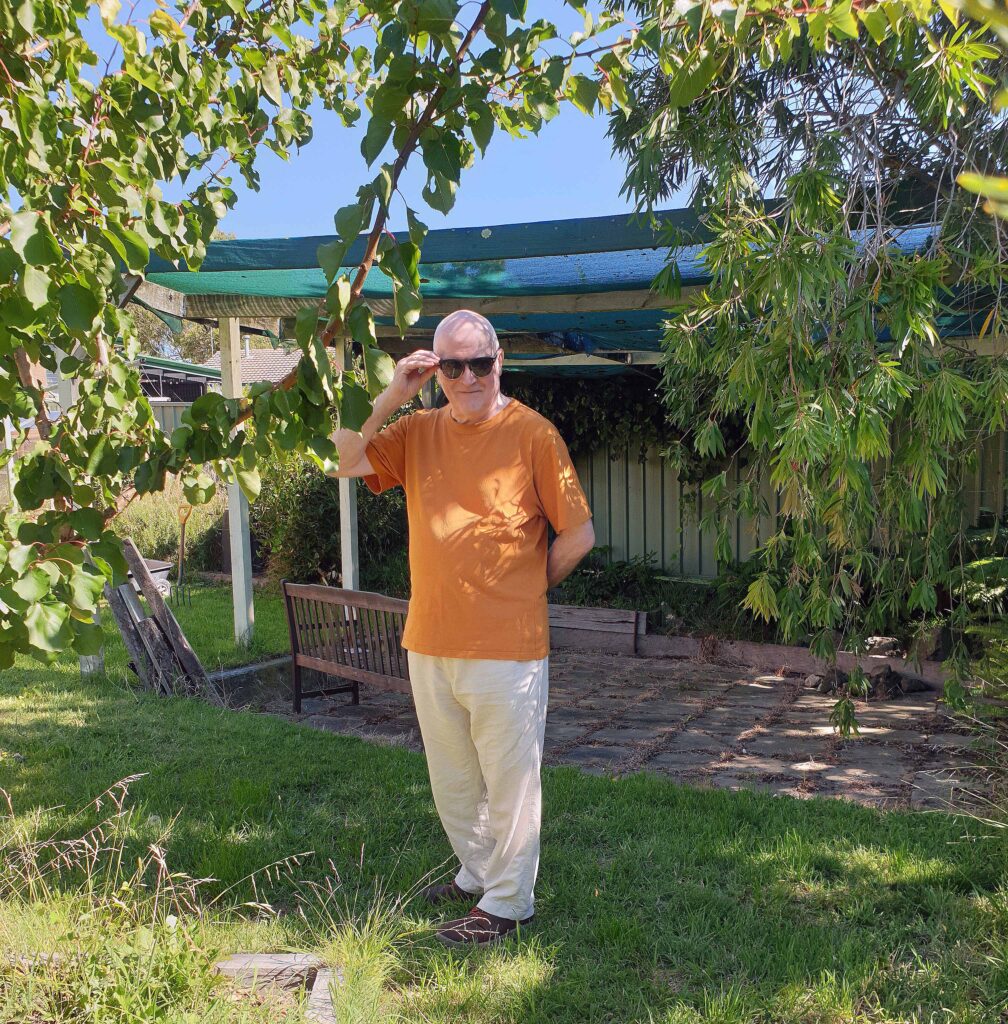
This is my own website, so I thought I would for once expand on my usual succinctly deflective biography. I had always thought of myself, and been thought of, as an Anglo-Australian composer, but since the Brexit débâcle I have abandoned the Anglo-: I am now an unhyphenatedly Australian composer. I also just passed a significant landmark: I have now spent more of my life in Australia than elsewhere. My music has been extensively performed, broadcast, and recorded, in Australia, North America, Europe and Asia—even in a tent in the Gobi desert. I dislike teaching formally and rarely do it, but many younger Australian composers have come to me to discuss their work, from Charlie Sdraulig and Kristian Ireland, to the late Luke Paulding, Vincent Giles, and David Murray, and, most recently, Hamish Madden.
After decades of city-hopping I have finally arrived in the city of Ballarat in Australia′s state of Victoria; already I have lived here for longer than any previous location, and I expect to stay for the remainder of my days. Beyond that, I can′t imagine why anyone would be interested in the minutiae of my life, so, apart from the broadest outline, I have omitted them in the biography below; what I have touched on throughout this site is the progressive evolution of my motivations and approaches, tastes and attitudes, and their context. No one, myself included, is likely to ever write a book on me – at least, I sincerely hope not. But reading a piece in the Guardian about memoir it occurred to me that this website is in fact my ‘memoir′, for what it is worth. I had previously been in two minds about the relevance of my frequent anecdotalising, but the fact is it adds context and a degree of explanation as to why this particular human took it upon himself to contribute these sounds to the world. Such explanations do seem to assist both performers and listeners in engaging with the music, so I will continue to provide a certain amount of personal reflection about and around the pieces when I come to upload them here. Even if it is unarguably a bit ‘me, me, me′.
I take the view that a composer is someone for whom there is a music that is intolerably absent from the universe, and who is in a position to fill that gap. In my case, I started writing music at about 8, the moment I began piano lessons – it never dawned on me not to: of course I was going to write stuff for myself to play, the material in my piano books was beyond dull. I am fairly confident, thinking back, that the realisation I was going to pursue a career as a composer had firmed by the time I was twelve; it is hard to believe today, but in the 1960s I was aware of classical composers having fairly glamorous, globetrotting lives. After about a decade of apprenticeship I wrote my first acceptable opus, a work called helical from 1976, and in this small work, despite its limitations, I hear my own personal soundworld for the first time. Back then I thought of it rather simplistically as a collision of Scriabin and Xenakis, but today I can see that many other threads were already present. Helical was, in part, a complicated homage to the Barraqué Sonate pour piano; my 2015-6 Piano Sonata is the fruition of a long-term plan to write a companion-piece for Barraqué′s monolithic masterpiece, contrasting his astringently modernist idiom with my own musical voice. It is pleasing to think that my selves at 23 and 63 had at least something in common. Is that what is meant by a creative arc?
As a composer I have been described variously as a modernist, a practitioner of the new complexity, and a maximalist, among less polite characterisations. My own view is that, if categorisation is unavoidable, I am best thought of as a Science Fiction Composer: many of my works draw on either science proper or science fiction for their imagery and structure, which entails use of a fairly advanced musical syntax to fully realise the concepts.
The present
I am now nudging 73; it is extraordinary to think that my Piano Sonata is already ten years old. For me it felt like a rubiconic work; as I came to finish it I felt a change in myself, the click of a psychic switch. For decades, and let′s face it, with a lot of encouragement from the musical establishment both in Britain and Australia, I had been troubled by Imposter Syndrome; I am after all a working class person from a small Kentish town: what might I possibly have to contribute to Western Classical music? But with the completion of this vast, complex score, I finally felt I had unambiguously and irrefutably written myself into musical history – I had validated, even vindicated, my work. Until 2020 and the COVID clampdowns, I used to regard myself as a slow writer. That is probably still true – I certainly can′t (or, at least, would rather not) write pieces in days, as some do – and I prefer only to work on a single piece at a time, but in the last half dozen years I have found my productivity escalating markedly. Whether that is because being locked-down caused a kind of renewed focus, or COVID brought home to me that time is finite, or the sense of liberation after finishing the Sonata undid some residual paralysis, I′m really not sure. Possibly it just dawned on me that I was genuinely a ‘retired person′, and therefore was free to work as hard as I liked – no more need to ration my stamina to sustain a day job. Besides, like much Australian wildlife I am naturally nocturnal, a way of being I had to forgo while still a wage-slave. The vast majority of my newest pieces were written between midnight and dawn, a time of strange uninterrupted suspendedness that I find productive. Even so, I am retrospectively surprised by the extent of my own recent worklist. For instance, since the beginning of 2020 I have written:
…nox est perpetua una dormienda (2020), the 8′ closing section of passing bells for piano
AB7 (2020), the final piece in an Ordre for piano (6′)
Luminous & Dark Integers (2020), two pieces for vibraphone (12′ + 12′)
ghosts of motion (2020), for clarinet d′amore (10′)
Arcanabula (2020), for bassoon (14′)
un petit mot crabe-c′est-ma-faute (2021), for trombone and percussion (12′)
Resuscitatîve (2021), for contrabass (13′)
chronology horizons (2021), for piano (~32′)
quiescence for BP (2022), for piano (10′)
the effort to return to the cities of the sane (2022), for bass clarinet (11′)
PdeJ 3 laminar flow (2022), for piano (also, the third movement of the Sonata de Jager) (12′)
solace of articulation (2022-3), for clarinet d′amore and ensemble (30′)
〈ʀ〉emote (2023), for soprano saxophone (10′)
in Platonia (2023-4), for bass clarinet and piano (25′)
‘…flickering instantiation…′ (2024), for harpsichord (11′)
silence (2024), for tenor saxophone (10′)
Arpisms (2025), for flute (13′)
vagantes (2024-5), three elegiae for piano (12′ + 24′ + 12′)
10 to the power 62 – Part I (2025-6), for soprano saxophone + twelve live or prerecorded saxophones (30′)
That′s getting on for six hours of music in six years, and a good hour of that music is for larger ensembles than I′ve addressed in decades. Despite the extent of that list, I wish I could work still faster in order to move on to new projects more quickly – it is frustrating that the nature of the job prevents much delegation, and I′m too old to do a Kerouac. My next job is to write Parts II (Anthroposphere) (10′) and III (20′) of 10 to the power 62. Once those are completed I will be turning my attention to a new symphony and an opera on Zamyatin′s We, not necessarily in that order. Ideas continue to churn.
The online New Music resource Score Follower has made a number of my works available in synced-score video form, and they can be accessed from here.
The past
XI 2010–2019…
After several years of living in the inner suburbs of Melbourne we finally tired of the urban noise and Kate and I removed ourselves to Black Hill, Ballarat. At last, after forty years of writing, I find myself with the mental and temporal space to approach new pieces and revisions somewhat less precipitately, taking (even more) time to prepare. I approach new pieces warily, gradually assembling a toolbox of single-work-specific materials; this process can take some time, but until it is prepared I am unwilling to commit to commencement of the score. Since moving to Ballarat I have, however, had the luxury of writing pieces from beginning to end in a single arc, which has obviated the prior necessity of leaving a complex and detailed paper-trail for myself to follow in case of major interruption.
Looking forward, it is hard to see great promise in the future for New Music. A debate on The Conversation asks the question ‘is music dying?’, with as reply, an article that does not even reference classical music, so deep is the author’s indifference (or so despairing his outlook). When books have to be published with such titles as Why Classical Music Still Matters and Who Needs Classical Music?, we can be certain that the thousand-plus year-old body of knowledge incarnate in, for instance, my works, has ceased to have any appreciable value for most Westerners. Even the nature of Western Culture is under reconstruction by its internal opponents; Tuchman’s description of Jean Gerson, Chancellor of the University of Paris in the late fourteenth century, believing that “he lived in the senility of the world, when society, like some delirious old man, suffered from fantasies and delusions”,[2] resonates with us today.
X 2008–2010
Newcastle, despite its real beauty, felt culturally imprisoning and Kate and I were happy to return to Melbourne in early 2007. In the thirty months we had been away the population of the city had grown by ten percent and we were shocked at how different it had become; although still feeling like “home” living there was no longer the pleasure it had been, and we realised that we would perhaps move on. For this reason, most of the work I did between 2007 and 2010 felt transitional, retrospective or prospective, but not current. Of the last few works I produced in Melbourne, tellingly, several were completions of earlier scores that, while treated as complete at the time, did not fully extend the architecture that I had developed for them. E(i)ther (“I in the ether”) from 2005 is one of these works, but I find that what there is of the score is sufficiently effective as to not require extension. Permutation City, also of 2005, however, was always intended to have the character of a journey from the very edge of a city into and through the CBD, and back out again. The city of Greg Egan’s novel has only a virtual existence, so I conflated it with the Renaissance concept of la città ideale,[3] while also hinting at Robert Graettinger’s underappreciated City of Glass. In 2008 I returned to the score and added the absent elements of this pilgrimage, making the piece both complete and much more effective.
Most telling of all is that the only work I completely finished while in this limbo was an Hypallage, a tiny piece of music-hall melodrama based on a text from Tristram Shandy. I did however begin a new sequence of small piano works called the heretical bagatelles, which are all cast as vignettes of friends or colleagues. The first to be written was BD & double, a homage to Brett Dean, and since then several more have emerged and more are planned. They form a subgroup of the Phase Portraits, the collective umbrella for my smaller piano works.
IX 2004–8
In 2003 I met Kathryn Sullivan, singer and musicologist, and moved with her to Newcastle NSW, where she was working towards a Masters’ degree. To support us I took a job with the Australian Taxation Office, which limited my composition time drastically, and I found it necessary to constrict my architectural choices. The works of this short period have a characteristic concision:
- passing bells: night (2003) for solo piano
- e(i)ther for violin and piano
- blood music (2005) for B flat clarinet, 7-string electric guitar, and quarter-tone vibes
- Agnî, from Agnî—Prometheus—Lucifer (2005-6) for 16 players
I also began my work for organ, compostela/finisterre (2005-9), but unlike these other works was unsatisfied by its short version; I subsequently extended it, and revised it further. Kevin Bowyer has performed both versions.
At the end of my Newcastle sojourn I was awarded my PhD by The University of Melbourne, in the course of which one of the examiners complained that my works should all have been computer-typeset, inadvertently expressing the wish that the scores be homogenised to a kind of industry norm. Andrew Bernard is also my engraver and he uses the Lilypond, and subsequently Dorico notation system; hardly a day passes without him contacting me for advice as to how to render my notational subtleties in a standardised format. As he regularly remarks, things that I can do spontaneously with a pencil take many man-hours of shoehorning via software into viable engravure. While I admire and appreciate his efforts in producing performance versions of some of my piano and guitar pieces, I shan’t mind if the majority of my scores remain handwritten.
VIII 1998–2003
By 1998 I was living in North Carlton and, while enrolled for a Masters’ degree at Melbourne University, producing works regularly for, among others, ELISION and Libra. Following on from ik(s)land[s], I began a series of works for small ensemble which were premièred by those ensembles, and appear on my NMC and Tzadik CDs. These include:
- eigenmomenta (2000-1)
- light-strung sigils (2002), written for Steven Niles’ ensemble Music of Changes
- the blinding access of the grace of flesh (2003)
- and, more recently, flux (2016), for ensemble Kupka’s Piano in Brisbane
For me, there is a consistency of expression and idiom between these works that emerges from the character of the small—Pierrot-derived—ensemble, and I have come to regard them as a loosely-bound, and as-yet incomplete, group. My proposed concerto for Carl Rosman’s extraordinary clarinet playing will form an eventual end-stop to the series, but more pieces may well creep in. As I gradually populate the sound-space that these pieces define I find myself increasingly drawn to contradicting that primness of sonic character and gradually turning it inside out (punking it up?)—but that journey is for the future.
eigenmomenta was a pivotal piece: in it I combined for the first time my two contrasted approaches to working. Ever since the Radulescu/Nunes epiphany I had sought to animate my musical gestures from behind, in a Platonist fashion, by adopting a high degree of self-similarity in the formal segmentation. In short, a) I structured architecture and rhythm as the same parameter, but at different speeds; b) I allowed the same segmentation to govern both time and pitch; and c) I derived that ur-segmentation from gematric versions of words—I allowed the symmetries of written language into my sonic structures.[5] Contrarily, I have allowed the lowest level of structural detail, what one might call the parole of the music, to be extemporised within the local constraints of tempo and harmony, the langue if you will. These two dialectical approaches appear as formal juxtapositions in eigenmomenta, giving the work a unique character in my canon. It is as if the trickledown architecture encounters a tarpaulin at the next-to-lowest level. I have a particular affection for this piece, even if I cannot give a satisfactory account of its title.
This formal duality is probably more clearly audible in another work: the sadness of detail (2003) for solo clarinet. A regular feature of my output since 1987, heralded by dé/ployé, has been works exhibiting a juxtaposition of formal foldedness and unfoldedness. In earlier works the un/foldedness has been presented within the same arch, but the sadness of detail presents the two structural formats as different manifestations of the same piece: the sadness of detail [intercut] and [linear]. Simultaneously, it presents the formal langue/parole duality in its plant-like unfolding. When Richard Haynes performed the work in his Listen, my secret fetish show, he wore only gladwrap stuffed with dried leaves, which I thought showed a deep understanding of the music. My forthcoming solo altoflute piece for Carlton Vickers, geminy, takes this pairing of dualities a step further by either nesting two folded structures within one another—perhaps unconsciously suggested by DNA—or presenting them side by side.
VII 1989–97
I arrived in Australia on 25 December 1989, fleeing from bitter British winter to high Sydney summer—a psychic as much as climatic seachange. My first months in Australia were inevitably somewhat of a shock: discovering the almost complete absence of Black Music with the sole exception of Michael Jackson; searching for and failing to find drinkable beer or edible cheese; living in a tenement; adjusting to the strange sartorial conventions. I also quickly became aware that my existing reputation here was that of a caricature effete pseudo-intellectual and consequently had already provoked the antagonism of the conservative wing of Australian composition, notably the anonymous anti-modernist Adelaide Pastoral Company.[6] This hostility provides at least some explanation why no application of mine was funded by the Australia Council between 1994 and 2011, a very effective torpedoing of any career momentum I might have achieved.
In 1994 I moved to Melbourne for the first time, and realised that I had found my permanent home. This feeling was enhanced by meeting a group of younger musicians and composers who were both like-minded and highly talented; among them, David Young, Adam Yee, and Carl Rosman. Despite various sidetrips of a couple of years each to Canberra and Newcastle NSW, Melbourne has continued to be my focus of activity ever since.
Once settled in the Melbourne suburb of Carlton, I began to wrestle with the issue that the more experimental aspects of my work were simply unpalatable to Australian performers and audiences, with very few exceptions. Although Daryl Buckley’s phenomenal ensemble ELISION and performers and composers associated with it were passionately onside, and committed to advocating music like mine, I realised that to achieve acceptance here required some compromise. By 1997 I had recognised that my idiom had to be rethought, and I regard my work for ELISION called ik(s)land[s] as the first mature expression of that shift in attitude.
Many of the works I wrote in those early Australian years exhibit the vestiges of my European sensibility, and no longer please me in their current form. These include mem(e), planetary allegiances, heterotic strings and ‘atsiluth/shin—all in my revision queue. Some, however, were less marred and have been permitted to survive:
- driftglass for percussion and small ensemble (1990-1)
- severance for guitar (1988-94)
- ruins within for clarinet in A (1992-4)
- ‘e/meth for oboe or soprano sax (1995)
- beyond status geometry (1995)
- Fourth Symphony, for four amplified voices and orchestra (1994/7)
VI 1987–9
At the end of the eighties I had had enough of England—in fact, I realised that living there made me miserable. So I abandoned Britain in disgust in 1987, and spent two years subjecting my then wife to the complications of living without much income in the beautiful but unaffordable garden of Tuscany. We were saved from this near-destitution by my being invited onto the DAAD Berliner Künstlerprogram, which was a year of serious productivity and socialising. At the end of the year, in 1989, after having left just before the Berlin Wall was torn down, I emigrated to Australia, and discovered just how hard it is to restart one’s life midterm.
This was the period in which I made the first important changes to my compositional toolbox. Impressed by the approaches of two quite different composers, Horatiu Radulescu and Emmanuel Nunes, I sought a way to liberate my work from the Englishness I perceived in it. The works I produced in this period seem to me to have a new confidence, in particular my four solo flute works: vier Därmstadter aphorismen, dé/ployé, sulle scale della Fenice, and closing lemma (1986-91). Other pieces I wrote in mainland Europe include funk (1989), and burns (1989).
V 1982–87
The eighties were not a good time in Britain. The baleful influence of Thatcherite conservatism threatened both artistic and social tolerance; for instance, my Argentinian composer colleague Alejandro Viñao changed overnight from an enrolled student to an enemy alien, and was temporarily banned from use of electronic music studios. I consequently spent a fair amount of time in mainland Europe, attending music festivals, in particular the Darmstadt New Music Summer School. A number of my works were performed internationally, although I now see that I was not ready for the exposure.
The works of this period that are not withdrawn for revision are few:
- into the wormworks (1984)
- tilt (1985)
- esperance (1986), all for solo piano
- and énoncé (1983-4) for large ensemble
All the other extant pieces are in the process of being recast and rewritten. In the floodlight of sudden international attention, I had effectively set myself compositional challenges for which I was not, at that stage, ready. Although the results were interesting enough, these pieces were failures, and not in the honourable Ferneyhoughian sense. Today I can see precisely how to achieve what I was aiming for in such works as my Second Symphony for brass and percussion, strangeness for string quartet, my Third Symphony “afterimages”, and recueillement; revising them is a major sideband of my current compositional activity.
In retrospect, I am aware that the primary feature I was trying to incorporate into my work was a quality of punk. I unconsciously felt about most English modernism of the time rather as the punks felt about Prog Rock: that it was feeble, smug, and mediocratisingly amiable. My attempts to insert a bit of edge, of dirt, into my pieces were less than entirely successful at the time, but I can recall even then describing their textures with terms such as ‘wirewool’ and ‘plasma’, not words that one might use of, say, Nigel Osborne. Finishing this empunktion process and liberating them to completion is a debt I owe these works.
IV 1977–82
In the late seventies I spent some time at the City University in London, in their newly inaugurated BSc music degree course, run by the brilliant Malcolm Troup. This was an innovative project, a music department in a university without an arts faculty. It was here that I met Xenakis, who was the visiting professor, and Trevor Wishart, the author of the ground-breaking On Sonic Art. I also began a lifelong fascination with the ideas of epistemologist Gregory Bateson. What I failed to foresee was that a BSc in music would require graduate-level mathematical and scientific abilities, which I egregiously lacked. As a result I dropped out of the course after two years, enormously better informed about anthropology, semiotics, ethnomusicology, and early music history, but without a clue how to map the propagation of a soundwave in a room.
Up to this point, if I couldn’t play a work of mine, it went unheard. One of the brighter moments in this period was when I first met Michael Finnissy, one of the single most fearsomely creative individuals I have ever encountered. He brought several of my piano works to life, and enabled me, for the first time, to hear my more experimentally-intended music. Like so many composers of my generation, my debt to him is incalculable.
From this era in my life emerge a handful of works I still acknowledge, despite their greater or lesser degree of derivativeness:
- zero-knowledge protocols (the ironic title a later superimposition) (1973)
- helical, (1976)
- tiento de medio registro alto, (1978) (a homage to Francisco Peraza and Robert Schuck, since revised)
- dancing qualia (1978)
- the Pas Seul pieces
- and most significantly, topologies, (1979).[7]
A violin and piano work called compulsion from 1978(?) won a prize in the Stroud International Composition Competition, but the performance was embarrassing, and the score was subsequently lost—I hope it reappears one day, I don’t recall it as being that bad. Also, my First Symphony received its controversial first performance in 1980. Written over a three-year period from 1977, I had despaired of ever hearing the piece and destroyed the score literally a week before the letter arrived notifying me of the intended performance …in three months’ time. A massive reconstruction effort ensued, that produced a rather more radical version of the work. Not everyone was convinced by its massive sonic broadside, but for me it was a benchmark—this was exactly how I wanted my music to sound.
III 1971–77
After leaving school early and self-educating for a while, in 1971 I entered a university renowned for hosting radically modernist composers such as Jonathan Harvey, Alexander Goehr, and Benjamin Boretz …at exactly the moment when most of them moved on to other campuses. The focus where I was had shifted to Handel Opera, which I learned to profoundly detest. Seriously disillusioned by this failure of academe to bend to my will, I managed to survive some months working in a bank, and moved on to a much more congenial occupation—the record retail industry, where I stayed for some years, actually learning something at last. This is why I often refer to myself as an autodidact.
Although I must have written a fair amount of music while floundering in southern England I can recall very little of it, and what I do recall was undistinguished—better it remain lost.
II 1964–71
I had the misfortune to be (non-)educated in a third-rate grammar school in Dover, Kent, at a time when the old and new curricula were being taught side by side—or, in my case, bafflingly, in alternating years. Consequently, I learned nothing adequately. My fellow students included Topper Headon from the Clash, Gary Barnacle the ubiquitous studio saxophonist, and Sir William Fittall.
I won my first composition competition in 1969—the Southern Television Young Composers Competition, which was notable only because they underestimated the likely number of competitors by an order of magnitude and had taken two years to adjudicate. The main result was my age becoming public and being banned from pubs.
Unfortunately, the works from this period are long-lost. I can remember some of the detail of a couple of them, but laboriously transcribing juvenilia is rather low on my priorities.
I 1953–63
I was born in London in 1953, in a hospital ward overlooking the Thames. I like to think I’m nearly a cockney.
Footnotes
[1] I have taken a vow never to be in the presence of snow ever again.
[2] A Distant Mirror: The Calamitous 14th Century, Barbara W. Tuchman, p 508, Alfred A. Knopf, 1978.
[3] As I have said elsewhere, for me conceptual metamorphosis is an essential element of creativity.
[4] Tuchman, p 98.
[5] I had long before become frustrated by the muteness of structures and symmetries drawn from Nature—I suppose I should not have been surprised that the numerologies of the natural world lacked content.
[6] ‘…around 1990 the resurgence of tonality among younger composers in Australia led to an unedifying series of exchanges in the pages of the Australian Music Centre Journal, where ‘maximalists’ and a shadowy group called the Adelaide Pastoral Company traded insults. This all generated much more heat than light and, the laws of thermodynamics being what they are, it ultimately ran out of energy; Australian composition now enjoys a state of détente or comfortable plurality, if not of mutual respect.’ New Classical Music: Composing Australia, Gordon Kerry. UNSW Press, Sydney 2009.
[7] In connection with topologies, I was intrigued to discover a mention online of myself as having been taught by the remarkable pianist Ian Pace. This would come as a surprise to him, I think, as we have probably spent less than three hours in each other’s company. What Ian might have taught me was not made clear—but then, I have never been much of a student. Perhaps it was a confusion from this, in which Professor emeritus Malcolm Troup reviews Pace’s excellent Tract CD, NMCD066.